

When you pay online, your payment information is actually processed by an online payment processor we have chosen. This allows us to avoid storing credit card information, and therefore places the processor in charge of handling your credit card data. Since this is their business background, and area of expertise, they are better suited to handle, and secure, this type of information.
Some customers have expressed the desire for their credit card number to be stored so they don't have to key it in again when they make their next payment. Given the fact that we do not physically use the card information ourselves we do not store it, so there's no way to retrieve it at a later time. Not storing this information protects you, as well as other cardholders. Some companies may choose otherwise but, with the knowledge that security breaches are becoming more of a concern, there is no real reason to store your credit card information if it's not being used.
Does this mean you'll always have to type in the credit card number? No. If convenience is a paramount concern of yours, you can merely use third party browser add-ons to assist you. These tools are freely available on the internet, and they're offered for nearly every browser. These tools store information, such as credit card numbers, you type on your computer. This keeps the credit card number in your possession, which enhances your protection.
Bottled water is now considered the second largest commercial beverage category in the U.S., and sales are showing no signs of slowing. Even though bottled water has a higher cost when compared to tap water, it is still the fastest growing segment of the beverage industry, second only to soft drinks.
People consume bottled water for a variety of reasons: convenience, healthier than sugar-based drinks such as sodas and fruit juices, etc. However it cannot be denied that much of the popularity is driven by marketing strategies that insist bottled water is cleaner and safer than tap water. However, is that really true and is the additional cost of bottled water really worth it? Here are the facts.
- Public water utilities are regulated by the Environmental Protection Agency (EPA) and the federal Safe Drinking Water Act. Bottled water companies are regulated by the Food and Drug Administration (FDA) under the Food, Drug, and Cosmetic Act. The regulations for the bottled water industry are different, and less stringent than those a water utility must adhere to.
- The average cost of our tap water is less than a penny per gallon. Depending on the size of the bottle purchased, bottled water can easily be more than a dollar per gallon.
- Tap water contains small amounts of disinfectants to protect against bacteria and microbes, while most bottled water does not. Given this fact, bottled water should not be stored for a long period of time once it has been opened.
- Tap water contains fluoride added at safe levels, recommended by the American Dental Association. This additive helps prevent tooth decay in children.
At Davidson Water, Inc. we take several steps to safeguard our customers against undesirable water quality. In recent weeks, there has been widespread concern across our nation regarding lead in drinking water and the potential corrosiveness of drinking water. Davidson Water, Inc. does not have lead pipe service lines or distribution system lines. The water in our distribution system does not have any lead present.
As a routine part of our operations, water quality is tested for pH as well as orthophosphate, an additive which protects pipes against corrosion. By maintaining strict control over the pH, we can minimize any potential corrosiveness in the drinking water as a result of natural and process factors. The orthophosphate then offers an additional barrier of protection against corrosion. Davidson Water, Inc. follows state and EPA guidelines for monitoring lead in our water system. For additional information concerning lead in drinking water visit the American Water Works Association Lead Resource Community Webpage or feel free to contact Davidson Water, Inc.
Lead in Plumbing
The EPA requires Davidson Water, Inc. to monitor for certain substances, one of which is lead. Davidson Water, Inc. test results have always been in compliance with EPA Lead and Copper Rules.
Elevated levels can cause serious health problems, especially for pregnant women and young children. Lead in drinking water comes primarily from materials and components associated with private service lines, commercial, institution and home plumbing. We are responsible for providing high quality drinking water, but we cannot control the variety of materials used in plumbing components in private homes and businesses.
When your water has been sitting for several hours, you can minimize the potential for lead exposure by flushing your tap for 30 seconds to 2 minutes before using water for drinking or cooking. Additional information on lead in drinking water, testing methods, and steps you can take to minimize exposure is available at EPA: Basic Information About Lead in Drinking Water .
Many customers do not fully understand what controls their water pressure. Several misconceptions regarding this are common, and this typically leads to confusion on the part of the customer.
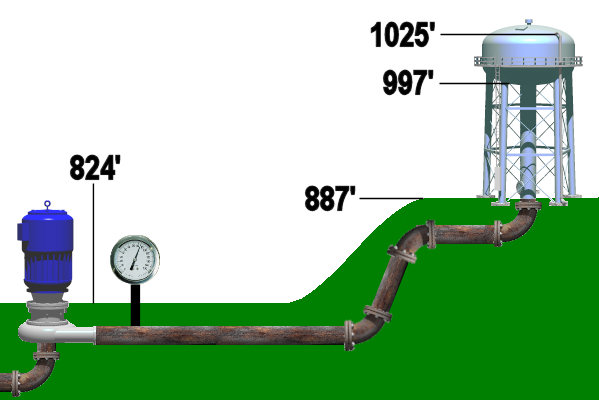
Although there are a few factors that can control pressure, it is primarily the result of the elevation difference between two points. In this illustration, we have a water tank and a pump connected by a water line. The ground elevation at the pump is 824' above sea level, while the ground elevation at the tank is 887'. The water is stored in the tank in what's referred to as the "bowl", which is at the top of the tank.
If the tank were full, the difference in elevation between 1025' (full tank) and 824' (pump station elevation) would be 201'. Every 2.31 feet of elevation equates to 1 psi of pressure, so dividing 201 by 2.31 gives us a pressure of 87 psi at the pump station. If the bowl was half full (1011'), the result would be 81 psi, while the bottom range of the bowl elevation (997') would give us a pressure of 75 psi. So the range of pressure at the pump station would normally fall between 87–75 psi.
Keep in mind that in peak periods of demand, customer demand can also pull the pressure down a few psi as well. There is also a circumstance where the pressure could be higher than 87 psi — when a pump is running to refill the tank, it can boost pressure to 95 psi or higher. Once the tank is full and the pump stops, pressure is once again dictated by the water level in the tank.
While this is a very simplified example, and our system is composed of many tanks, pumps, and nearly 2,000 miles of water line, it should illustrate that pressure is controlled by the ground elevation and the general operation of the system itself.
Due to increasing security concerns, we routinely examine what methods of encryption are available when you communicate with our website. This is called PCI Compliance, and it establishes guidelines that help protect confidential data, such as your credit card number.
As of June 25th 2018, we disabled support for early TLS encryption methods. This may affect certain users on older computers and outdated web browsers. If affected, it will simply look like our site is unavailable because your computer or browser is not capable of using modern encryption methods.
To prevent this, make sure your computer and web browser are compliant with current PCI standards. You must use both a compliant Operating System and a compliant web browser.
Compatible Operating Systems
- Windows 7, 8, 8.1 or later
- Mac OS X 10.9 or later
- iOS 5.x or later
- Android 5.x or later
Compatible Web Browsers
- Internet Explorer 11
- Microsoft Edge
- Google Chrome 30 and above
- Mozilla Firefox 27 and above
- Apple Safari 7 and above
- Opera 17 and above
*In Windows 7 and Windows 8, support for TLS 1.2 is not enabled by default. Ensure you are current on Windows Updates and follow the Microsoft article on enabling TLS 1.1 and TLS 1.2 .
On occasion, you may receive an estimated bill. This will only occur when the circumstances demand it — when your meter reader cannot get to your meter for reasons such as a hazardous dog, heavy rain, or snow.
Any estimate made is based upon your previous water usage, and any error in doing so will be automatically corrected when the meter is read the next time. Keep in mind that many of our meters are now radio-read meters, and just because we do not visit the meter box every month does not mean the meter is being estimated.