

Leaks are often the reason of unexplained increase in water consumption. The most common source of leaks is the toilet. A running toilet can waste hundreds of gallons of water in a single month, and often times are silent. Other sources of leaks include dripping faucets, a break in the service line between the meter and the residence, sprinkler systems, or automatic fill on the swimming pools. We would like to offer the following tips on how to identify if you have a leak, and encourage each customer to monitor their homes. Monitoring your home and service line will save water and save you money!
Bathroom
To help determine if you have a leaking toilet, simply remove the tank lid and place a few drops of food coloring, or a dye tablet, in the toilet tank.
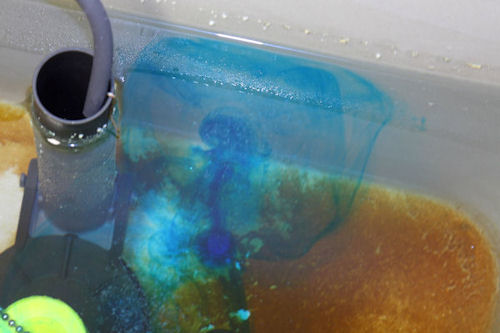
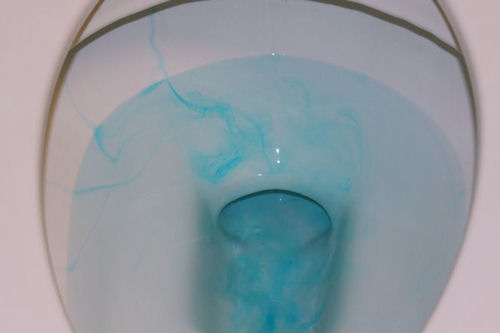
Do not flush for at least one hour. If the coloring penetrates into the bowl, you have a leak. In most cases, this leak is easily repaired, by replacing the toilet flapper and/or filling mechanism.
Service Line Leaks
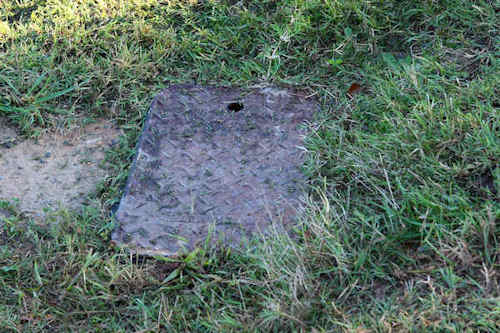
Find your meter box, which is typically located in the front of the property near the street. Remove the lid off the meter box and lift the protective cover.
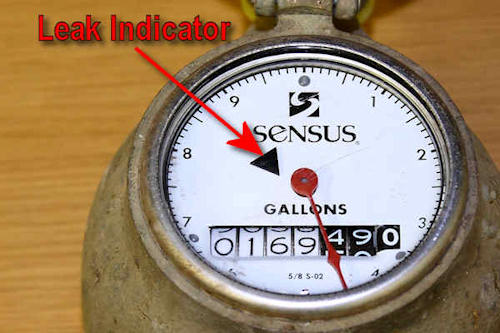
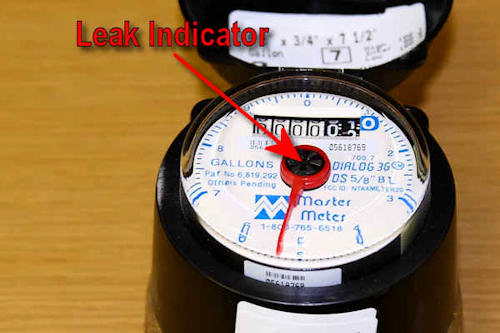
After locating the meter, take a reading on your meter, and also check to see if the leak indicator is turning. Depending on the brand of your water meter, the leak indicator could be a small triangular shaped dial or a small disc that rotates when water is flowing.
If the leak indicator is turning, you may have a leak. However, if the indicator does not move at the time you are taking the reading it does not verify that you don't have a leak. A slow leak may not register with the indicator. Therefore, wait at least two hours without using water, and take another reading on the meter. If the numbers have changed, you are losing water, which indicates a possible leak.
If Water Conservation measures are in effect, some of the conservation tips below might not apply. This is because the Water Conservation restrictions may prevent using water in some of the situations below. For more information about Water Conservation rules, and our Water Shortage Response Plan.
General
- Install Faucet Aerators.
They use less water, even if you're turning on the taps for the same amount of time. You should be able to get faucet aerators for less than two dollars apiece. Chances are you already have some form of aerator in your faucet (they're those little mesh screen pieces that screw onto the nozzle). If you already have them, you can unscrew them and check the side for their gpm (gallons per minute) rating. If it's over 2.75 gallons, it's probably worth it to get one with a better, lower rating.
Repair Faucet Leaks. A leaky faucet can waste 1000-2000 gallons of water a year.
Utilize Greywater. Save unused drinking water, capture water while you're waiting for the shower to heat up and hang on to your cooking water, then use it to water your plants.
Insulate Pipes. Cover your hot water pipes with foam insulation to prevent heat loss. The pay off is faster hot water and less water waste.
Place Your Hot Water Heater Close to Where You Use It. The shorter the distance the water has to travel, the faster you'll have hot water. Less time waiting equates to less water wasted.
Install a Tankless Hot Water Heater. When it's time to replace your hot water heater, consider upgrading to a tankless unit (also known as an on-demand water heater). It heats water faster and only when you need it, a water savings and an energy savings.
Do you have a fish tank? If so don't throw the dirty water down the drain when you clean it. Instead use the water for your houseplants — the nitrogen and phosphorous rich water is a great fertilizer for plants.
When the temperatures dip below 32 degrees, the water in your home's pipes are at risk of freezing. The tips below will help you prepare and thaw your pipes if they have frozen.
Preventing Frozen Pipes, Before the Weather Turns Cold
- At the end of summer, drain swimming pool supply lines and lawn and landscape sprinkler systems. (Do not put automotive antifreeze in drained lines; it is toxic to animals and plants).
- Remove, drain, and store outdoor hoses. If hose bibs have shut-off valves, close them and drain faucets. If no shut-off is available — or if frost-free faucets have not been installed — cover faucets with insulation or Styrofoam covers.
- Install thermostatically-controlled heat lamps in pump houses.
- Survey property for other water supply lines that may be unprotected: unheated basements, attics, crawlspaces, and garages; under cabinets on exterior walls; at the water meter; at the point where main supply lines cross the foundation into the house. Insulate both hot and cold water lines in these areas (hot water lines freeze as readily as cold water lines if water is not flowing through them).
- Protect exposed pipes by wrapping with foam pipe sleeves (taping at all junctions), covering with fiberglass insulation, or installing UL-listed heat tape or heat cable. Even several layers of newspaper will do in a pinch when temperatures aren't expected to remain cold for prolonged periods.
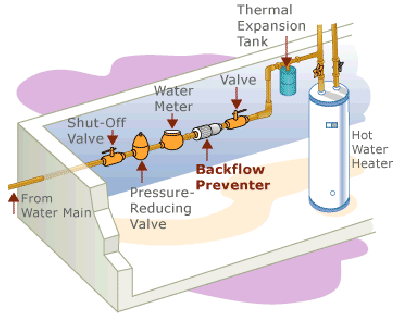
Davidson Water, Inc. requires the installation of a backflow prevention device within your water meter box in order to protect the distribution system from potential cross connections or backflow from a customer. Such cross connections or backflow could result in pollution and/or contamination of the water system.
When a backflow preventer device is installed in your meter box, water from the building/house will be unable to flow back into the water system. The backflow preventer creates an isolated or closed plumbing system. For some homeowners, thermal expansion could produce leaky faucets or set off the relief valve on hot water heaters, or in some cases, other damage may occur. Thermal expansion occurs when your hot water heater heats the water, causing it to expand.
In order to control thermal expansion, simply lowering the temperature setting of the hot water tank to 115–125 degrees (which is sufficient for most purposes) might reduce the possibility of thermal expansion.
A plumber may recommend the installation of one of the following two types of products to control thermal expansion:
Thermal expansion tank on your hot water heater. Layout shown below is for demonstration purposes only.
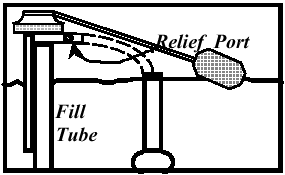
A toilet tank ball cock fill valve, anti-siphon backflow preventer and thermal expansion relief valve, all in a single assembly.
A pressure-reducing valve may also be required if your water pressure exceeds 70 psi (pounds per square inch).
Davidson Water, Inc. is dedicated to providing you with superior quality drinking water that exceeds federal standards. With the installation of a backflow preventer after your water meter, you can feel confident that we are protecting you and your family as well as your neighbors and community.
For more information regarding thermal expansion and thermal expansion products you can view this pamphlet from a manufacturer of thermal expansion products.
Water is incompressible. Unlike air, it's impossible to squeeze any quantity of water into a smaller volume. Where that matters is in "closed" water systems such as a water heater with a check valve (pressure regulator and the like) ahead of the heater. When the water gets heated it expands and that extra volume has to go someplace. Without an expansion tank the pressure could rise to a dangerous level in a closed system. A diaphragm type of expansion tank is a pressure vessel that contains a flexible membrane totally separating the water from a captive volume of air. Air compresses and as the water temperature rises, creating extra pressure/space, the air in the vessel accommodates that increase, thereby preventing a potentially dangerous pressure rise.
The reason for the hole is to break siphonage effect when the water is shut off and there is a drain down situation. A common example would be in a mobile home water heater, where the water supply is nearly always under the floor. If the water gets shut off, without that hole, the diptube could possibly backsiphon and empty most of the water, potentially burning up the elements or damaging the near-empty water heater. Bottom line, it's for safety.
Check to see if you have check valve type nipples installed on the top of your water heater. They generally look like ordinary galvanized nipples and so sometimes it is hard to tell if they are installed. Some water heaters come with them. They are a great idea because they can save some energy, but they also can be very annoying.
Regardless of whether you view your bill online, or receive it in the mail, there's a lot of information packed onto it. At first the information found on your bill may appear rather daunting, but once the various items are explained you will quickly realize how easy the bill is to interpret.
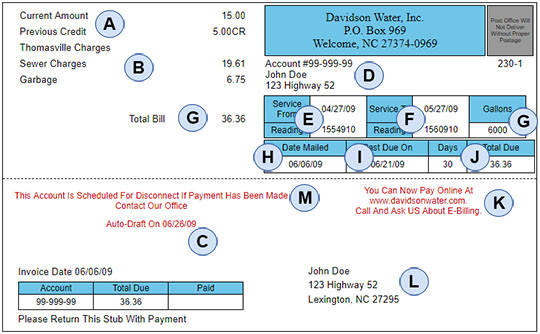
A. Water Charges: This area shows the amount you owe for your water usage. If you have a credit, or past due amount, it will be shown here as well.
B. Other Charges: In some cases, you may also show charges for other services such as city sewer or garbage collection. If that's the case, it will show up here.
C. Auto-Draft Message: If your bill is currently being auto-drafted, you'll see your draft date shown here. At times, other messages may possibly be shown here.
D. Account Number and Physical Address: This area shows your account number, as well as the physical address of your water meter. This may or may not be the same as the mailing address shown below.
E. Service From: This is the beginning date of the current bill's service period, and includes the previous month's reading.
F. Service To: This is the ending date of the current bill's service period, and includes the current meter reading. The number of days this billing period covers is shown just below.
G. Gallons Used: This is the gallons of water used between the Present and Previous readings.
H. Date Mailed: This is the date your bill was printed and mailed.
I. Past Due Date: This is the date your bill will be considered late.
J. Total Due: This is the full amount you currently owe.
K. Misc. Message: This is a miscellaneous message area. Various customer information will appear here when necessary.
L. Mailing Address: This is your current mailing address, and is where the bill is being mailed to.
M. Scheduled Disconnect Message: If your bill is currently scheduled for disconnect due to a past due bill, you'll see a notice here. At times, other messages may possibly be shown here.
If you are experiencing high water pressure, your problem should revolve around the Pressure Reducing Valve (PRV). The PRV is usually a bell-shaped device, and is most often found where the line enters the building (although it may possibly reside at other locations).
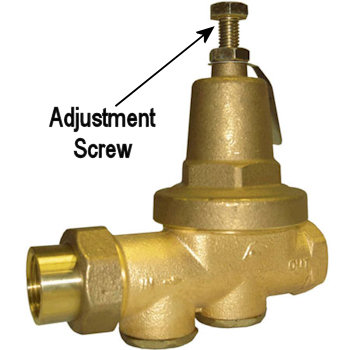
No PRV: While a plumber should have installed a PRV in situations where the pressure is around 70 psi or higher, there may be circumstances where the PRV was never installed. If this is the case, have a PRV installed and then adjust it if necessary.
Improperly Adjusted PRV: An improperly adjusted PRV will not reduce the system pressure to a desirable level. Usually the reduced pressure should be around 70 psi. If the PRV is set too high, use the adjustment screw on the PRV to reduce the downstream pressure. Warning: improper adjustment could result in water leaks or pipe failure.
Malfunctioning PRV: A malfunctioning PRV can possibly not restrict the pressure enough. If the adjustment screw on the PRV doesn't seem to reduce the pressure, the PRV likely needs to be replaced.
If you begin to experience a decrease in water pressure, the issue will often be within your plumbing system. Below are some of the common things to look for when troubleshooting a low pressure condition.
Pressure Reducing Valve (PRV): If the low pressure condition is present throughout the system, you should check your PRV. This is usually a bell-shaped device, and is most often found where the line enters the building. If the PRV is improperly adjusted, or has failed, it can result in a pressure loss, or even no water, downstream.
Clogged Aerators: If the low pressure is isolated to a certain faucet, the problem may simply be a clogged or blocked aerator. Unscrew the end of the faucet, and check the aerator screen for rust, debris, scale or other particles that may be restricting flow. In some cases it may be easier to simply clean or replace the aerator altogether.
Hot Water, Low Pressure: If the low pressure seems to only be affecting the hot water, there could be a problem with your water heater. Check the shut-off valve near the water heater, making sure it is fully open. You may need to consult a licensed plumber to evaluate the condition of your water heater.
Shut-Off Valve: Many homes and businesses have a master shut-off valve. The location can vary, but most of the time it will be located in a separate box behind the meter or near the PRV. Even if slightly closed, this valve can restrict flows and decrease the water pressure.
Mineral Deposits: In older homes, plumbing such as galvanized piping can often be found. Over time, mineral deposits can form on the inside of the pipe and thus decrease the inside diameter, as well as making the inner surface rough. Although this corrosion does not pose a health threat, it will restrict your flow and pressure. If you determine this to be a problem, your only solution is to replace the affected plumbing with copper or PVC.
Water Leak: A leak can affect your water pressure as well. To learn how to determine if you have a leak, see our section on how to check for water leaks.
Water System Demand: If the pressure seems slightly lower at certain times of the day, you could be seeing the result of a peaking demand on the water system. There are generally two peak periods throughout the day — first thing in the morning and in the evening when people are getting home from work. During these times, you may notice a decrease in pressure, but you should still have sufficient water.